
The Trap of “Cloud Thinking” in an AI World
Every major technology shift invites comparison to the last one.
One of my prior posts, drew debate from readers about how the on-prem to cloud transformation compares to the AI transformation. I’ve lived through both (cloud at Thomson Reuters, cloud + AI at Sitecore, AI at InsiderOne), and the parallels are tempting.
But this is exactly where many leaders could get into trouble.
While cloud and AI transformations rhyme, they are not the same kind of strategic shift. Treating AI as “Cloud 2.0” leads to the wrong investments, timelines, and expectations for value creation.
This post is about separating what carries over from the cloud technology shift and what does not, and why the playbooks that built the SaaS era can quietly break your AI strategy.
Where the Similarities End
It is worth acknowledging the similarities briefly, because ignoring them creates blind spots.
Like cloud, AI is a platform shift, not a feature cycle.
Like cloud, it rewards early conviction over “wait and see” approaches.
And like cloud, it creates valuation dispersion, lifting some companies while leaving others behind.
But the mistake many leaders make is assuming that because the outcomes look similar, the mechanisms must be too.
They are not.
Cloud was a transformation of delivery.
AI is a transformation of capability.
That distinction changes everything.
Delivery vs. Capability
Cloud shifted software:
From on-premise to hosted
From capex to opex
From bespoke and custom deployments to standardized and configurable platforms
The economics improved. Adoption expanded because access became easier.
But the capabilities within the software themselves remained largely deterministic and static.
AI changes what software can actually do.
It shifts products from passive tools to active systems. Systems that observe, decide, act, and improve over time. That is not a delivery upgrade. It is a capability upgrade.
And it requires leaders to unlearn some deeply embedded SaaS instincts.
The Concrete Shift: System of Record vs. System of Action
The difference becomes obvious when you look at something familiar, like CRM.
In the cloud era, the CRM transformation was moving a server from the basement to the browser. A big part of the value proposition was linking the economics to usage. As a customer, your invoices were aligned with your usage. At Sitecore, as we transitioned from on-prem to SaaS, we also executed a business model and pricing shift with customers, moving them to perpetual licenses to subscription contracts.
The other advantage was access. Sales teams could log calls from anywhere. Managers could see the pipeline in real time.
But the work was still manual. The human did the work. The software stored the result. The CRM was a System of Record.
In the AI era, the transformation is cognitive.
The system listens to the sales call, updates the record automatically, predicts close probability, and drafts the follow-up email.
The software is doing the work.
That is a System of Action.
Applying a system-of-record strategy, valuation multiple, or diligence framework to a business that has not crossed that gap is how investors and boards misprice AI exposure.
The Operator’s Cheat Sheet: SaaS vs. AI
For leaders navigating this shift, the strategic levers have changed.
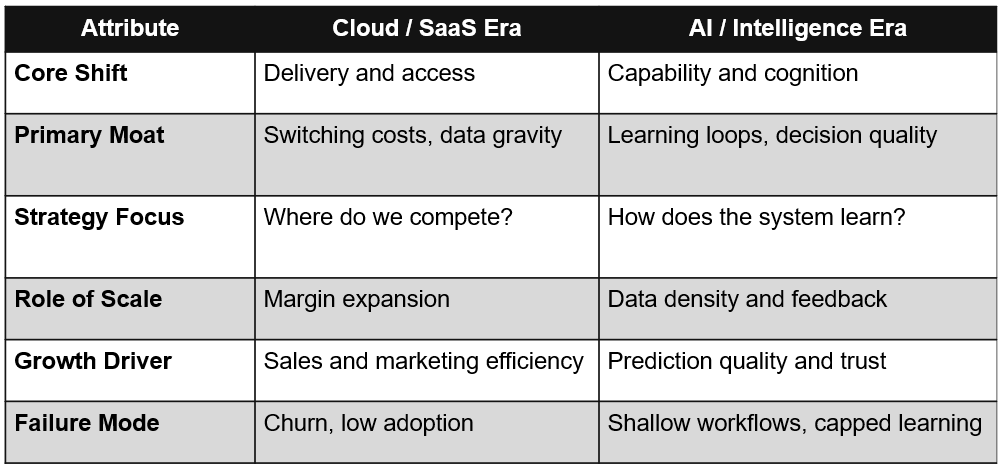
Five Strategic Pivots for the AI Era
1. From Positioning to System Design
In the SaaS era, strategy is centered on market selection, ICP definition, and packaging. Pick the right wedge and execute well, and you could win.
In AI-native businesses, strategy starts with system design.
Where does learning happen?
How does feedback enter the system?
Which decisions are automated versus augmented?
In SaaS, strategy answered “where do we compete?”
In AI, strategy answers “how does our system get smarter faster than competitors?”
That is not a product question. It is a systems question.
2. From Margin Scale to Learning Velocity
Cloud platforms benefited from traditional economies of scale. More customers meant better margins, stronger ecosystems, and greater leverage.
AI uses scale differently.
Scale matters because it creates data density. Data density feeds learning. Learning improves decisions. Better decisions attract more usage. That loop compounds or it does not.
Two companies can have identical ARR and radically different futures. One is compounding intelligence. The other is simply scaling infrastructure.
The market increasingly prices the difference.
3. From Product-Centric to Workflow-Centric
In SaaS, you could win with a great UI and broad horizontal functionality. Deep workflow ownership helped, but it was not required.
In AI, shallow integration creates a structural ceiling.
AI systems are only as good as the context they see and the actions they can take. If a product sits on top of a workflow rather than being embedded within it, the feedback needed to improve intelligence is limited.
Feature breadth without control points produces compelling demos, but weak defensibility.
This is why AI-augmented SaaS and AI-native systems diverge so quickly over time.
4. From Efficiency to Compounding
Cloud transformations emphasized operating leverage. Cost reduction, margin expansion, and SKU rationalization were rational and often effective.
Applied blindly, those same tactics can damage AI potential.
AI value is created by improving decision quality over time and reducing error rates through iteration. That requires investment in data infrastructure, model tuning, and human-in-the-loop feedback.
Cost-cutting does not create intelligence. In many cases, it starves it.
5. From Roadmaps to Operating Models
One of the most overlooked differences is organizational.
In SaaS, strategy could live comfortably in product roadmaps and GTM plans. In AI, strategy lives in the operating model.
Who owns data quality?
Who is accountable for model performance in production?
How are feedback loops governed?
Where do humans stay in the loop?
AI strategy cannot live solely in product or engineering. It collapses boundaries between strategy, operations, data, and execution. Management teams and boards that miss this often fund tools instead of systems.
The Time Asymmetry Most Leaders Miss
SaaS laggards could often catch up with enough capital and execution. AI is less forgiving.
Learning curves are path-dependent. Early data advantages compound. Feedback loops deepen over time. Some gaps cannot be closed later with spending alone.
This makes sequencing more important than polish, and early architectural decisions more consequential than feature velocity.
“Wait and see” is rarely neutral in AI. It often means falling behind in ways that are difficult to reverse.
The M&A Trap: A Note for Investors and Boards
For those evaluating AI exposure through acquisition or transformation, diligence questions must evolve. I discuss 9 key diligence areas for AI acquisitions in my post “AI-Ready M&A: How Acquirers Should Evaluate AI Compatibility.”
Not every SaaS asset can become AI-native. Some are not broken, but they are bounded. Recognizing that early is a strategic advantage. I also talk through which assets are worth backing for an AI transformation, and which are not, in a different post here.
Closing Thoughts
Cloud and AI are both described as transformations, but they operate on different axes.
Cloud transformed the economics of software delivery.
AI transforms the nature of software itself.
In the cloud era, you won by selling access to software.
In the AI era, you win by selling the work the software does.
Leaders who keep applying cloud thinking to AI will struggle to explain why their products look similar, but their outcomes diverge. The ones who unlearn those instincts early will quietly build systems that pull away.
That is the real edge in this cycle.
If you’re building, buying, or operating in this space, I’d love to compare notes.
You can reach me at faraaz@inorganicedge.com or on LinkedIn.
