
About me
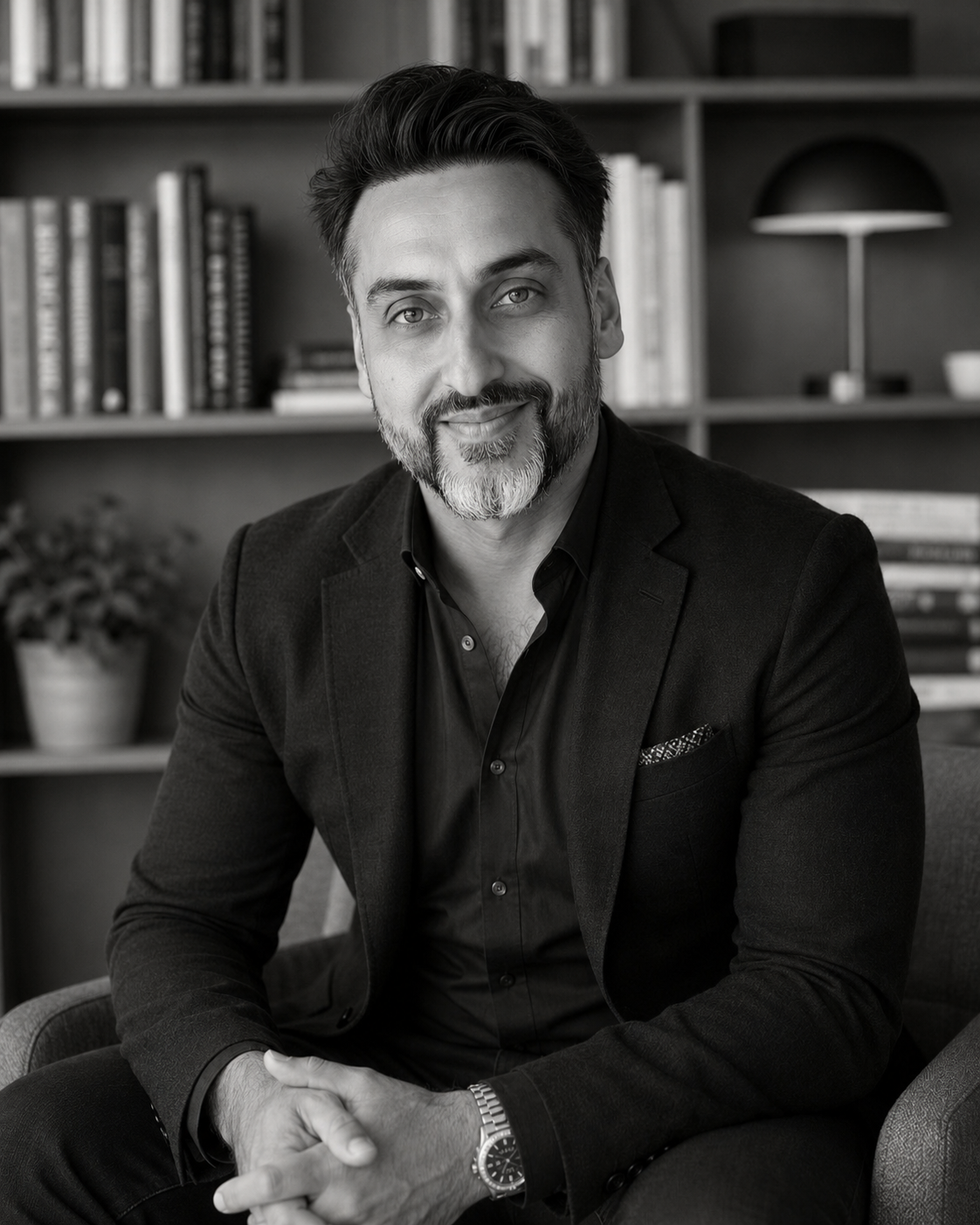
I'm Faraaz Khan. I build corporate development functions for software, AI, and technology companies, and then lead the M&A programs they were built to execute.
I've done the job from several sides of the table: investment banker, strategist, and operator, working directly with CEOs, boards, and investors. That range affects how I look at a deal. I can think about the strategy and economics, get the transaction done, and still live with the decision as the person responsible for making it work.
I grew up in the UAE, the youngest of four brothers in an immigrant household where working hard wasn't praised. It was just what you did. At 17, I left the UAE on my own to attend college in the United States.
I started at EY, moved into investment banking at Macquarie, and earned master's degrees from the London School of Economics and INSEAD along the way.
Being an investment banker during the 2008 financial crisis taught me a lesson that has stayed with me through my career:
a deal can be flawless on paper and create almost no value.
Capital is fuel, not direction. I've helped raise more than $1.9 billion across PE- and VC-backed companies, but I've always seen capital as a means to execute a strategy, not the strategy itself.
That realization about value creation is what pushed me out of banking and into strategy consulting at Booz & Company. I wanted to get closer to the question that comes before the deal: where is this business actually going to create value, and what does it need to do differently to get there?
Consulting brought me closer to those decisions, but eventually I wanted to own the outcome rather than hand over the recommendation. So I moved inside companies as an operator.
At Thomson Reuters, I worked on the turnaround and eventual carve-out and $3.55 billion sale of its IP & Science business, about 25% above where analysts had valued it.
At Sitecore, a PE-backed software company, I built corporate development from scratch, led seven acquisitions worth roughly $1 billion, helped put a $1.2 billion growth plan to work, and built strategic alliances with Salesforce and Microsoft as we turned a single-product company into a broader software platform.
At Insider One, I built corporate development from scratch again, helped raise a $105 million Series D, led the company's first acquisition, a conversational AI business, and helped build out a partnership program that became a meaningful source of revenue and growth. That acquisition also gave the company an early position in conversational AI just as generative AI was taking off. Two years later, I helped raise a $500 million Series E at roughly twice the valuation, including a partial exit.
The companies were different, but the work followed a familiar pattern: understand where the business can win, define the strategy, then use M&A, partnerships, and capital raising, to help make it happen.
I've worked across the US, Europe, the Middle East, and Asia. Along the way, I've built relationships across markets and learned how differently people make decisions, establish trust, and respond to risk.
That matters in corporate development because the work is inherently cross-functional. A deal can involve founders, engineers, sales leaders, finance teams, investors, lawyers, and a board, all looking at the same decision from different angles. A large part of my job is understanding what matters to each of them, finding the points of alignment, and keeping the work moving.
I don't start with the assumption that the answer is a deal. I start with what the business is trying to accomplish.
You may be better off building the capability internally. An acquisition may get you there faster. A partnership may give you the advantage without the cost and complexity of buying. And sometimes the right decision is to sell something that no longer fits.
My job is to help make that choice, get people aligned behind it, and execute.
AI is making these decisions more consequential. Software companies are deciding which capabilities they should build themselves, which AI-native businesses are worth buying or partnering with, and where legacy products still deserve investment.
I like working on those questions because the consequences are real. A bad decision can consume years of management attention and a lot of capital. A good one can materially change where the company goes next.
That's also why I created The Inorganic Edge.
I write about buy-and-build, AI M&A, partnerships, integration, capital allocation, and the decisions companies face when organic growth alone won't get them where they want to go.
It's for founders, CEOs, CFOs, investors, and corporate development leaders who care less about announcing deals and more about whether they were worth doing.
That's ultimately what interests me too: helping a company decide what it needs to become next, making the moves required to get there, and staying close enough to the outcome to know whether they actually worked.
If your company is figuring out what comes next, or looking for the person to help make it happen, let's talk.
You can reach me at faraaz@inorganicedge.com or on LinkedIn.