
Unified Platforms: The Real Moat is Built Before You Build AI
Right now, almost everyone is marketing an “AI-first platform.” In my experience, most teams are bolting AI onto a patchwork of products and data, then acting surprised when the results don’t stick beyond the demo.
After working across multiple software platforms at very different stages, I’ve come to a simple conclusion: The advantage isn’t the model. It’s the underlying system: unified workflows, a single source of truth, and loops that get better with use. AI amplifies that. It rarely substitutes for it.
AI is the tool, not the foundation.
This pattern showed up long before “AI-first” became a marketing phrase. It showed up in different categories, different eras, and different market conditions. The technology changed. The logic didn’t.
The Pattern Most AI Strategies Miss
Across successful platform transformations, the same ingredients repeat:
Unique, proprietary data sets generated by real customer workflows.
A unified platform, not a stitched collection of point tools.
Closed feedback loops where actions generate data that improves future decisions.
Automation replacing rules, not just augmenting them.
When those elements are present, platforms improve naturally. Customers get more value from the platform than the sum of its parts.
I’m pretty opinionated on this after seeing it up close: a suite often shares pricing across products that still have separate data and separate truths. A platform has a shared data layer and shared intelligence. AI tends to make that distinction painfully obvious.
In the world of AI, companies that build the system first and then use AI to accelerate it are the ones that will win.
Sitecore: From CMS to a Force Multiplier for CMOs
When I joined Sitecore in 2017, the situation was clear. The business was under pressure. The Content Management System (CMS) category was commoditized. Every vendor sold roughly the same product with a thin layer of personalization.
Customers were stitching together large numbers of tools to make their digital experience stacks work. Nothing truly stood out. My job was to help the CEO and team pick a clear direction, then use M&A and partnerships to make it real. And the answer wasn’t “a better CMS.”
The breakthrough wasn’t a better CMS. It was recognizing that content without feedback is wasted effort. This was a real customer pain point that we heard repeatedly.
One large global customer made the problem obvious. They were shipping mountains of content across thousands of webpages, but couldn’t answer a basic question: what’s actually working? Personalization was still a spreadsheet of rules and exceptions. There was no loop from “what we publish” to “what users do” to “what we should do next.”
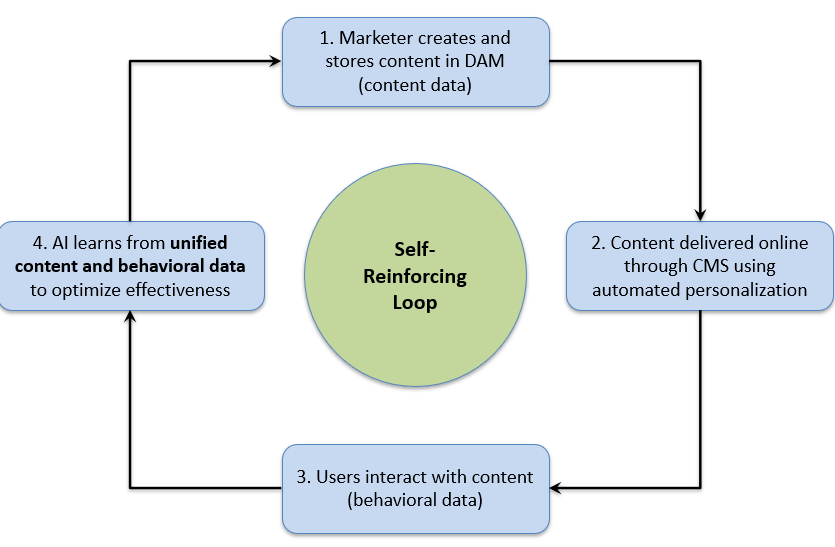
So we built that loop.
First, we acquired Stylelabs, a digital asset management (“DAM”) and content operations platform. This gave us structured data about the content itself—where it was created, tagged, and stored. Second, we used Sitecore’s delivery layer to activate that content and capture real-time behavioral signals.
What changed everything was connecting content operations to real behavioral signals, then using ML to learn patterns instead of hand-maintaining rules.
Instead of marketers maintaining hundreds of brittle rules, the system learned which combinations of content, context, and audience drove outcomes. Because data flowed in both directions, every future batch of content the marketing department developed was smarter and more effective.
At that point, the narrative flipped. We weren’t selling CMS anymore. We were selling measurable outcomes. We were a force multiplier for the CMO.
AI didn’t create the advantage. The unified system did. AI was just the accelerator.
InsiderOne: One Deal, Exponential Impact
When I joined InsiderOne, it was clear that it had something rarer than it should be: a single clean data layer and teams already using it to ship real predictive features.
Unlike peers who had stitched together disparate point solutions, Insider had built a clean, single data layer from the ground up. We also had a strong, existing AI team that was already shipping predictive capabilities, not just talking about them.
In Q4 2022, we came across a small messaging-focused vendor. Initially, it looked like a straightforward channel acquisition. But after spending time with the team, it became clear the opportunity was much bigger.
They weren’t just a channel provider. They had deep expertise in conversational workflows, and their product direction was moving toward a fully conversational, prompt-driven interface.
Because our underlying data was clean and our architecture was unified, we didn't face the usual integration nightmare.
We moved quickly, completing the acquisition in January 2023, before the broader AI wave fully hit. We plugged their conversational engine directly into our existing AI fabric. That immediately simplified how customers interacted with the product, but the real key was the data.
Clicks are noisy. Conversations are usually clearer because users tell you what they’re trying to do in their own words. By moving to a conversational interface, we started capturing high-fidelity intent data, users telling us precisely what they wanted to do. This "volunteered data" became immediate fuel for our existing models.
The timing helped, but it wasn’t luck. Because the foundation was already in place, we could integrate fast and ship fast, while others were still untangling data and architecture.
It repositioned Insider as an AI-forward platform at precisely the moment attention peaked. But that speed was only possible because of the foundation. Unified data and an authentic AI culture already existed.
What This Means for AI Today
This is why so many AI initiatives disappoint. They’re layered onto fragmented data, shallow workflow ownership, and brittle logic.
AI usually doesn’t fix those problems. It surfaces them faster.
Real AI advantage is built when:
Workflows are unified.
Data flows end-to-end.
Decisions generate feedback.
Learning compounds over time.
That’s also why M&A works when it reinforces a system and fails when it adds tools. And why timing matters. Early system decisions are path-dependent. Some advantages can’t be bought later, no matter how much capital you deploy.
The Takeaway
The winners in this cycle won’t be the companies with the flashiest AI demos. They’ll be the ones with unified platforms, proprietary data, and reinforcing loops that improve intelligence every day.
AI will dramatically accelerate those systems. But the real advantage was built before the model ever shipped.
If you’re building, buying, or operating in this space, I’d love to compare notes.
You can reach me at faraaz@inorganicedge.com or on LinkedIn.
Author’s Note: Examples in this post are described at a high level and reflect personal experience and publicly observable patterns, not confidential company information.
