
How to Monetize Your AI Roadmap: A Framework
AI features are everywhere now. They are shipped fast, dominate earnings calls, and fill roadmap slides. Every product team is racing to add AI capabilities like summarization, co-pilots, assistants, and agents.
But a dangerous pattern has emerged beneath the surface: usage is splitting away from revenue.
This isn't about bad models or customers not understanding the value. The problem runs deeper. Most AI gets built as a capability, i.e., a better way to complete a task. But revenue only follows products, i.e., a new way to own an outcome.
Enterprise AI spending hit $37 billion in 2025, a 3.2x jump from 2024. Yet, McKinsey reports that this spending represents less than 1% of total software application spending. Companies spent roughly $50 billion on AI infrastructure, yet the application layer generates a fraction of that in actual revenue.
If your customers can access your AI value without changing how they buy, renew, or expand, your revenue flatlines. You have increased your Cost of Goods Sold (COGS) without touching your Annual Recurring Revenue (ARR).
This guide provides a framework for understanding where your AI sits on the value ladder, and more importantly, how to climb it.
The Four-Level Framework
Understanding where your AI sits on this ladder determines everything about how you price it—and whether it monetizes at all.
Level 1: Capability — "Our AI can do X"
Monetization: None. This is table stakes.
Level 2: Feature — "Our product includes X"
Monetization: Bundled/free. Improves retention, doesn't drive expansion.
Level 3: Product — "X solves a problem you pay for"
Monetization: Premium add-on or new SKU. Customers pay because removal hurts.
Level 4: Digital Labor — "X does the job of Y people"
Monetization: Outcome-based pricing. Competes with headcount budget.
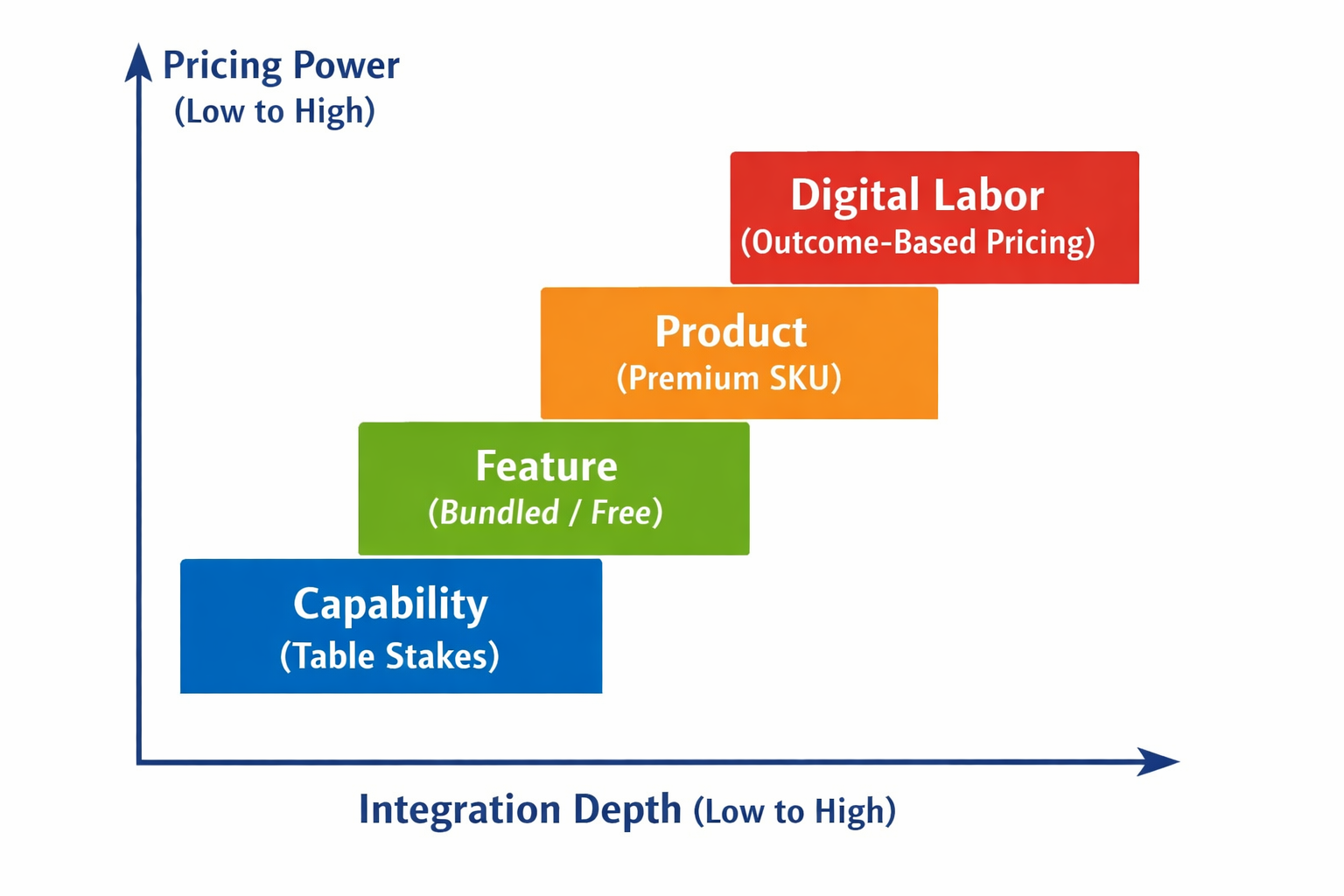
Most AI initiatives stall between Level 1 and 2. Revenue lives at Level 3 and 4. Here is how to navigate each level.
Level 1: Capability (Table Stakes)
This is the foundation. What can your AI can do in theory? "Our AI can summarize documents." "Our AI can generate code suggestions." "Our AI can draft emails."
Why it doesn't monetize: Capabilities are commodities. Every major AI model can perform similar tasks. Customers don't pay for potential; they pay for integration, reliability, and outcomes.
What to do: Don't stop here. A capability is your starting point, not your endpoint. The question isn't "what can our AI do?". It's "what problem does it solve, and how do we make it indispensable?"
Level 2: Feature (Retention Play, Not Revenue)
At this level, AI is embedded into existing products as an enhancement. It makes things faster, smoother, or more convenient. Customers appreciate it, but view it as a quality-of-life improvement that should come standard.
Example: Zoom AI Companion Zoom made a bold bet in 2023: bundle advanced AI features free with all paid accounts. The result? Usage went up. Revenue growth did not. By 2025, Zoom's revenue grew just 3.4% annually while competitors charging for similar AI features captured premium pricing. The problem wasn't the technology; it was the positioning. Zoom treated AI like cloud storage: a commodity feature that comes standard.
The Pattern at Level 2: A 2025 pricing study found that 29% of companies bundle AI features for free, while 24% charge a premium, and 11% are still figuring it out.
What drives success here: Focus on retention. Level 2 AI should make your core product stickier and reduce support friction.
The limitation: You won't expand revenue here. If it feels like spellcheck, it's free. To monetize, you need to climb higher.
Level 3: Product (Premium Pricing for Pain Removal)
At this level, AI isn't a feature. It's a distinct offering that solves a specific problem customers will pay for. The key difference: removing it would break someone's workflow or cost them money.
Example of Success: GitHub Copilot GitHub Copilot doesn't just "help" developers. It fundamentally changes how they code. By 2025, it reached over $2 billion in ARR. When Cursor emerged as a competitor, it reached ~$500M in ARR quickly by offering even deeper codebase understanding. The market validated that workflow integration isn't a nice-to-have. It's virtually the entire value proposition.
Cautionary Example: Notion AI Notion didn't just add AI; they bet on it as a standalone revenue stream, launching a $10/month add-on for writing assistance. Initial adoption was strong, but defensibility collapsed fast. When Apple, Google, and Grammarly made text generation a free commodity, Notion’s pricing power evaporated. By May 2025, they were forced to fold the feature into premium tiers to defend retention rather than drive expansion. The market proved that workflow integration cannot protect a price tag if the underlying capability is free elsewhere.
What You Need to Succeed at Level 3:
Deep Workflow Integration: Is your AI in the critical path? Tools embedded in core workflows show 2-3x higher retention rates than adjacent tools.
Clear Economic Ownership: Who owns the outcome? For Copilot, engineering managers own "developer velocity" and fight for the budget.
Defensibility: Notion AI tried to live here, but struggled as writing assistance became ubiquitous. To sustain Level 3, your AI must be significantly better or deeper than the free alternatives.
Level 4: Digital Labor (Outcome-Based, Highest Value)
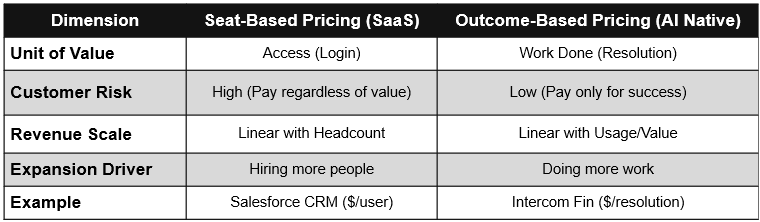
This is where AI transcends "software" and becomes "work." You are not selling access to a tool. You are selling outcomes. The pricing reflects this: you charge for resolutions, completions, or results, not seats.
Example of Success: Intercom Intercom charges $0.99 per resolution. You only pay when the AI successfully resolves a customer issue. Their AI agent, Fin, now generates "tens of millions" in revenue and resolves over 1 million tickets weekly (equivalent to 6,500 human agents). The real genius in Intercom’s monetization strategy is that they kept seat-based pricing for platform access but layered outcome-based pricing for AI work. They capture the value of the work being done, not just the people doing it. This also makes a ton of sense, considering that uptick in Fin adoption, would drive a reduction in number of seats.
Cautionary Example: Klarna Klarna's AI assistant initially did the work of 700 full-time agents, projecting $40 million in profit improvement. However, by May 2025, Klarna began rehiring human agents because customer satisfaction dipped. The lesson is that economic ownership requires owning the quality, not just the cost. If your AI saves money but degrades the brand, the CEO will kill it. To stay at Level 4, your AI must have "Human-in-the-Loop" quality barriers so it never breaks trust.
To succeed at Level 4, you must pivot your pricing model.
The Audit: 3 Questions for Your AI Roadmap
As you plan your AI investments, run every feature through this diagnostic to determine if it’s a Feature (Level 2) or a Product (Level 3/4).
1. The "Turn-Off" Test
If we removed this feature tomorrow, would customers call Support to complain about a bug, or would they call Sales to complain about lost revenue/productivity? Support = Feature. Sales = Product.
2. The "Workflow" Test
Does the user have to leave their current workflow to use this (Sidebar/Chatbot), or does it happen inside the workflow (Inline/background)? Sidebar = Optional (Hard to price). Inline = Essential (Pricing power).
3. The "Budget" Test
Which specific line item on the customer's P&L does this replace? If you can't name the line item, it is a free feature. If it replaces "Outsourced Support Costs" or "Translation Vendor," it is Digital Labor.
Moving Up the Ladder
You don't have to start at Level 4. But you do need a plan to climb.
Start with Capability (Level 1): Build the foundation.
Test as a Feature (Level 2): Bundle it to validate usage and drive retention.
Pivot to Product (Level 3): Once indispensable, create a premium tier for power users.
Scale as Labor (Level 4): Restructure pricing to capture the value of the outcome, not the seat.
Morgan Stanley estimates that AI-driven productivity could add 30 basis points to 2025 net margins for S&P 500 companies. The companies that capture this value won't just add AI features to existing products. They'll create new categories of value.
But here's the truth most earnings calls won't tell you: AI doesn't monetize by being impressive. It monetizes by being unavoidable.
When your AI sits in the margins, it gets margin pricing (or no pricing at all). When it owns the outcome, when removing it would break someone's workflow or cost them money, that's when revenue follows.
If you’re buying, building, or integrating in this space, I’d love to compare notes.
You can reach me at faraaz@inorganicedge.com or on LinkedIn.
Sources
AI Monetization & Enterprise Spending
Menlo Ventures: The State of Generative AI in the Enterprise 2025
https://menlovc.com/2025-the-state-of-generative-ai-in-the-enterprise/
McKinsey & Company: The Economic Potential of Generative AI (2025 update)
McKinsey: Evolving Models and Monetization Strategies in the AI SaaS Era
Morgan Stanley: AI Impact on S&P 500 Margins (2025)
https://www.morganstanley.com/ideas/ai-productivity-earnings
Zuora: Monetizing AI: Why SaaS Companies Are Missing Revenue Opportunities
https://www.zuora.com/resource/monetizing-gen-ai-why-saas-companies-are-missing-out/
AI Adoption & Implementation
Chargebee: State of SaaS Pricing 2025
https://www.chargebee.com/resources/reports/state-of-saas-pricing-2025/
Chargebee: The Monetization Reality: How Companies Are Monetizing AI
Orb: AI Pricing & Monetization Trends Report 2025
Developer Tools & Productivity
GitHub Copilot: The AI-Powered Developer Experience
https://github.blog/news-insights/product-news/github-copilot-workspace/
Microsoft: Work Trend Index: AI at Work
TechCrunch: Cursor AI Reaches $500M ARR
McKinsey: Unleashing Developer Productivity with Generative AI
AI in Customer Service & Operations
Klarna: AI Assistant Results & Update
Financial Times: Klarna Rehires Human Support Staff (May 2025)
https://www.ft.com/content/klarna-ai-customer-service-reversal
Harvard Business Review: Digital Tool Adoption & Retention Rates
https://hbr.org/2024/11/the-hidden-costs-of-digital-transformation
AI Feature Monetization Case Studies
Zoom: AI Companion Product Information
Zoom: AI Companion 3.0 Launch (Zoomtopia 2025)
Cavell Group: Zoomtopia 2024 Analysis: AI Companion Monetization Strategy
https://www.cavell.com/zoomtopia-2024-we-had-questions-did-zoom-have-answers/
Yahoo Finance: Investor Reactions to Zoom AI Companion 3.0
https://finance.yahoo.com/news/investors-reacting-zoom-zm-unveiling-121721346.html
Skywork AI: Notion AI Review 2025: Pricing Changes & Feature Analysis
https://skywork.ai/blog/notion-ai-review-2025-features-pricing-workflows/
Sacra: Grammarly vs Notion: AI Monetization Strategies
Pricing Strategy & Monetization
Simon-Kucher & Partners: Global SaaS Pricing Study 2024-2025
https://www.simon-kucher.com/en/insights/saas-pricing-study-2025
Bessemer Venture Partners: State of the Cloud 2024
Intercom: Fin AI Agent Outcome-Based Pricing
Stripe: Intercom's Outcome-Based Pricing Case Study
Stripe: Intercom on the Evolution of Value-Based Pricing for AI Agents
Growth Unhinged: Intercom's Decisive Bet on AI
Sacra: Intercom at $343M Revenue (2024)
Sequence HQ: How Intercom Cracked Outcome-Based Pricing
https://www.sequencehq.com/blog/how-intercom-cracked-outcome-based-pricing-with-finai
Ibbaka: Comparing Intercom's Fin AI Value Model and Pricing Model
Monetizely: The 2026 Guide to SaaS, AI, and Agentic Pricing Models
https://www.getmonetizely.com/blogs/the-2026-guide-to-saas-ai-and-agentic-pricing-models
UserPilot: Monetizing in the AI Era: New Pricing Models for SaaS
Market Analysis & Investment
Sequoia Capital: AI's $600B Question
Andreessen Horowitz: The Demo-to-Deployment Gap
